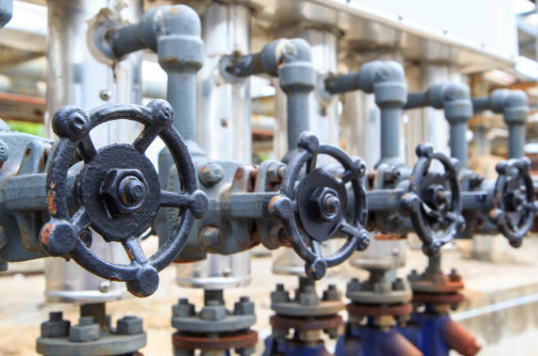
Industrial valves are classified by function, with five types dominating most industrial systems: gate valves, globe valves, ball valves, butterfly valves, and check valves. Each type has unique working principles and application scenarios, making proper selection critical for system efficiency.
Gate valves act as “on-off” switches for large-diameter pipelines. Their gate-like disc lifts to allow full flow, resulting in minimal pressure drop—less than 1/5 that of globe valves . Ideal for water supply, oil, and gas transmission, gate valves are commonly used in DN800+ pipelines in projects like the West-East Gas Transmission. However, they cannot regulate flow and require full opening/closing to avoid disc damage.
Globe valves are the “precision regulators” of the valve world. Their plunger-like disc moves vertically to adjust flow, with an opening-flow relationship that enables precise control . Widely used in steam systems and chemical processing, globe valves excel in applications requiring accurate flow modulation, such as boiler steam control and laboratory reagent dosing. Note that their complex flow path causes higher pressure drop, so they’re not suitable for large-flow systems.
Ball valves are the “quick-action workhorses” with a 90° rotating ball to control flow. They open/close in seconds, making them ideal for frequent operation in oil and gas pipelines . Soft-seated ball valves (PTFE seats) offer zero leakage (ANSI Class VI), while metal-seated versions withstand high temperatures up to 600℃. Marine platforms often use ball valves with anti-static devices to prevent explosions in flammable environments.
Butterfly valves are the “lightweight solution” for large-diameter pipelines. Their disc-shaped closure element rotates to control flow, and their compact design makes them 1/3 the weight of gate valves of the same size . Used in HVAC systems, wastewater treatment, and power plants, butterfly valves are cost-effective and easy to install. Triple-eccentric butterfly valves provide tight sealing for high-pressure applications like gas pipelines.
Check valves are the “one-way guardians” preventing media backflow. They operate automatically via media pressure: rising stem check valves for low-flow systems and swing check valves for high-flow pipelines . Installed at pump outlets and steam lines, check valves protect equipment from water hammer and reverse flow damage. 缓闭止回阀 (Slow-closing check valves) reduce water hammer by closing in stages, making them ideal for residential water supply systems.
When selecting valves, consider flow control needs (on-off vs. regulation), pipeline size, pressure, temperature, and media type. For example, ball valves for gas, globe valves for steam, and butterfly valves for HVAC.